
Emet Finance
Explore Emet Finance—a stable, accurate and connected platform built to manage every finance need with confidence.
Book a tour
Overview
Emet Finance manages your complete financial operations—from general ledger, receivables, payables and cash management to budgeting, financial reporting and audit-ready final accounts with proven accuracy, control and reliability.
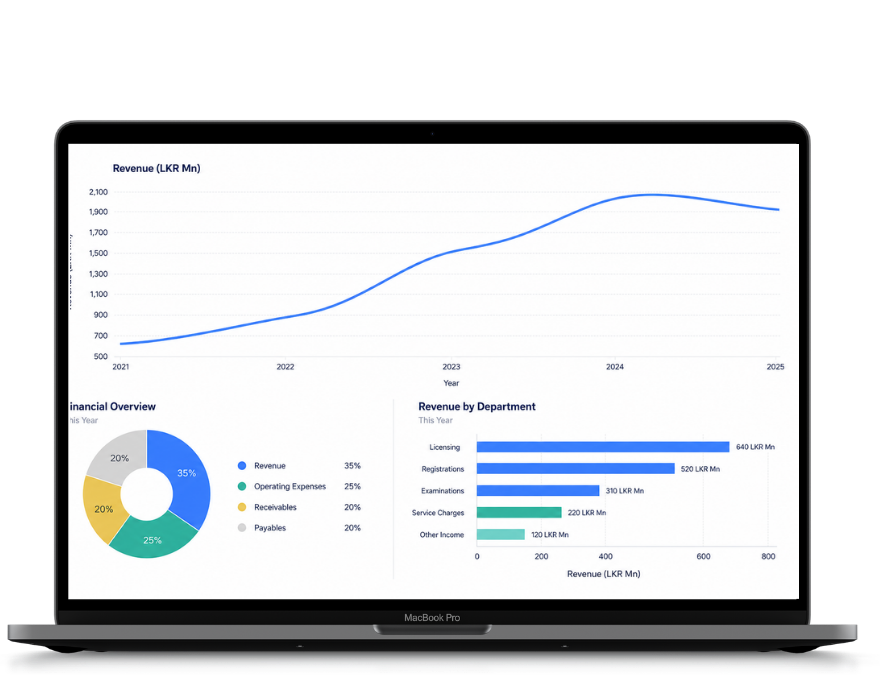
Powerful financial capabilities for complete control
Manage everyday accounting, control organizational spending and understand exactly where every payment belongs through one connected financial management platform.
General Ledger
What is General Ledger?
General Ledger is the central accounting record of an organization. It brings together income, expenses, assets, liabilities and equity within a structured chart of accounts.
Why do you need it?
A properly maintained General Ledger is essential for knowing the organization’s true financial position. It provides the accounting foundation required for period closing, audits, financial statements, statutory reporting and dependable management decisions.
How does Emet Finance help?
Emet Finance provides the complete foundation expected from a modern accounting system, including configurable account structures, journals, opening balances, adjustments, period controls and connected financial postings.
Transactions can be classified beyond the account code itself. An organization can identify the exact section, department, project, job, activity, funding source or cost centre associated with a transaction. This creates a much clearer financial record than a general expense entry alone.
Because financial activity is recorded using this detailed structure, the same information can later be analyzed at organization, departmental, project or individual job level without maintaining disconnected spreadsheets.
Accounts Receivable
What is Accounts Receivable?
Accounts Receivable manages money owed to the organization by customers, clients and other paying parties. It includes invoices, receipts, credit adjustments, outstanding balances and collection activity.
Why do you need it?
Organizations must know who has been charged, what has been paid, which balances remain outstanding and what amounts have become overdue. Without this control, revenue collection can become delayed, incomplete or difficult to reconcile.
How does Emet Finance help?
Emet Finance maintains customer accounts, invoices, receipts, settlements, credit adjustments and outstanding balances within one controlled financial environment.
Income can be classified according to the responsible section, service, project, job or revenue source. This makes it possible to understand not only how much money was received, but also where it came from and which operation generated it.
Finance teams can review customer histories, outstanding balances and collection status while management receives a clearer view of revenue performance and expected future receipts.
Accounts Payable
What is Accounts Payable?
Accounts Payable manages amounts the organization must pay to suppliers, service providers and other external parties. It covers supplier bills, payment requests, credit notes, settlements and outstanding obligations.
Why do you need it?
A controlled payable process helps prevent duplicate payments, unauthorized spending, missed due dates and supplier disputes. It also provides an accurate view of upcoming financial obligations.
How does Emet Finance help?
Emet Finance controls the complete payable process from recording supplier obligations to approval, payment and final settlement. Finance teams can monitor pending bills, due dates, completed payments and unpaid liabilities.
A key capability is the ability to identify exactly what each payment is for. A payment can be allocated to a particular section, department, project, job, activity, cost centre or budget item instead of being recorded only as a general expense.
Even when one supplier payment covers several purposes, the amount can be distributed across the relevant projects, jobs or expense categories. This provides accurate cost visibility and allows management to trace how organizational funds were actually used.
Bank Reconciliation
What is Bank Reconciliation?
Bank Reconciliation compares the organization’s recorded financial transactions with actual bank statements to identify timing differences, missing entries, bank charges and other discrepancies.
Why do you need it?
The balance recorded in an accounting system may temporarily differ from the bank because of uncleared payments, deposits in transit, bank charges or incorrect entries. Regular reconciliation ensures that cash and bank balances remain dependable.
How does Emet Finance help?
Emet Finance provides a structured process for comparing accounting entries with bank transactions and identifying unmatched or incorrectly recorded items.
Teams can investigate differences, record necessary adjustments and confirm cleared transactions without losing the original financial trail. This improves the accuracy of cash balances and reduces the manual effort required during month-end and year-end closing.
Reconciled bank information also strengthens cash-flow monitoring because financial decisions are based on verified cash positions rather than incomplete or outdated balances.
Budgeting & Controls
What is Budgeting?
Budgeting is the process of planning how organizational funds will be allocated and used during a particular financial period. Budgets may be prepared for accounts, departments, projects, jobs, activities or other areas of responsibility.
Why do you need it?
A budget becomes truly useful when it actively supports financial control. Organizations need to compare planned spending with actual spending, identify available balances and prevent commitments or payments from exceeding approved limits.
How does Emet Finance help?
Emet Finance allows approved budgets to be entered and maintained according to the organization’s own financial structure. Budgets can be allocated by account, section, project, job, programme, activity, cost centre or financial period.
When a payment or financial commitment is processed, the system can check it against the relevant budget. Depending on the organization’s policy, transactions that exceed the available allocation can be blocked, restricted or forwarded for additional authorization.
Finance teams can continuously compare budgeted amounts, committed amounts, actual expenditure and remaining balances. This helps prevent uncontrolled spending and gives responsible officers a clear picture of how much funding is still available.
Budget information can also be combined with expected income, outstanding obligations and planned payments to prepare more realistic cash-flow forecasts and identify possible funding shortages before they affect operations.
Project & Job Costing
What is Project and Job Costing?
Project and Job Costing identifies the income and expenditure related to a particular project, contract, assignment, service, activity or operational job.
Why do you need it?
A normal expense total may show how much the organization spent, but it does not always explain which project or job consumed the money. Detailed costing is needed to measure efficiency, profitability and financial performance accurately.
How does Emet Finance help?
Emet Finance allows transactions to be recorded against the exact project, job, section, cost centre or activity responsible for the cost. The same payment may also be divided among several projects or jobs where necessary.
This detailed allocation makes it possible to calculate the actual cost of a project, compare it with its budget and identify which activities contributed most to the final expenditure.
Management can review costs at different levels, from an organization-wide summary down to a specific section, project or individual job. This provides stronger control over resources, pricing, performance and project profitability.
Income Integration
What is Income Integration?
Income Integration connects the finance system with the operational systems and service channels through which the organization earns or collects money.
Why do you need it?
When income is recorded separately from finance, staff may need to enter the same transaction more than once. This can cause delays, duplication, posting errors and differences between operational and accounting records.
How does Emet Finance help?
Emet Finance can receive income transactions from a Point of Sale system or another operational income source used by the organization. This may include service collections, customer payments, rentals, fees, sales or other organization-specific revenue.
Connected transactions can be posted to the appropriate accounts and classified according to their revenue source, section, service, project or activity. This reduces repeated data entry while preserving the details required by finance.
The organization gains one consolidated view of income even when payments originate through different counters, branches, applications or service channels. This supports faster reconciliation and stronger control over revenue collection.
Workflow Integration
What is Workflow Integration?
Workflow Integration connects financial transactions with the organization’s required checking, recommendation, authorization and approval processes.
Why do you need it?
Financial activities should not depend only on informal communication or paper documents. Different transactions may require different approvals based on their value, purpose, department or level of risk.
How does Emet Finance help?
Emet Finance workflows can be configured according to organizational roles, responsibilities and authority levels. Each transaction can move through the appropriate officers for verification, recommendation and final approval.
Approval paths may change according to factors such as transaction type, payment value, department, project or available budget. Higher value or exceptional transactions can automatically require approval from a higher authority.
Users only perform the financial actions allowed by their assigned roles and authority limits. The system maintains the transaction status and approval history, providing clearer accountability and a traceable path from the original request to final completion.
Connected ERP Operations
What are Connected ERP Operations?
Connected ERP Operations bring finance together with the wider organizational activities that create financial transactions, obligations, assets and commitments.
Why do you need them?
Financial information often originates outside the finance department. Purchases, inventory movements, payroll, fixed assets, loans and other operational processes can all affect accounts, budgets and cash flow.
How does Emet Finance help?
As part of the wider EmetERP environment, finance can work with relevant information generated through procurement, inventory, fixed assets, payroll, loans and other organizational operations without treating every area as a disconnected system.
Approved operational transactions can produce the appropriate financial effect while retaining their original business context. Finance teams can therefore understand not only the accounting entry, but also the purchase, asset, employee-related transaction, loan or activity that created it.
This connected structure reduces duplicate entry, improves consistency and gives management a more complete view of spending, commitments, resources and financial performance across the organization.
Financial Reports
What are Financial Reports?
Financial Reports present the organization’s financial position and performance through ledgers, statements, balances, schedules and other structured accounting outputs.
Why do you need them?
Reliable financial reporting is required for audits, statutory responsibilities, internal financial control and communication with stakeholders.
How does Emet Finance help?
Emet Finance produces financial information from a consistent accounting source, helping teams prepare ledgers, trial balances, income and expenditure statements, balance sheets, cash-related reports and supporting schedules.
Reports can be filtered or analyzed according to financial periods, accounts, departments, projects, jobs, activities and other configured classifications.
Because the underlying transactions retain their detailed financial context, users can move from a summarized figure to the related entries for verification, reconciliation and audit support.
Management Reports
What are Management Reports?
Management Reports transform accounting and operational data into information that helps leaders evaluate performance, control spending and make informed decisions.
Why do you need them?
Management needs more than final accounting statements. Decision makers require timely visibility into budgets, expenditure, commitments, income, cash availability and the performance of individual areas of the organization.
How does Emet Finance help?
Emet Finance provides management-level analysis of budget utilization, actual and committed expenditure, outstanding receivables, supplier obligations, income performance and available financial resources.
Reports can show precisely how much has been spent by department, section, project, job, activity or cost centre. Management can compare budgets with actual results and identify unusual spending or underutilized allocations.
Expected income, upcoming payments and available balances can also be brought together to support cash-flow planning. This helps management identify possible shortages, prioritize payments and make financial decisions before problems affect operations.
Why industry leaders choose Emet Finance

Benefits of Emet Finance
Improve Accounting Accuracy
Reduce repeated data entry, minimize manual errors and replace disconnected spreadsheets with one structured accounting system.
Gain Real-Time Financial Visibility
Monitor income, expenditure, budgets and cash positions through current financial information, dashboards and meaningful reports.
Close Every Period with Confidence
Simplify reconciliation and period-end activities with complete, traceable records that support accurate financial reporting.

Challenges Emet Finance Solves
Time-Consuming Manual Processes
Automate repetitive accounting activities and simplify everyday financial workflows, saving time and reducing administrative effort.
Disconnected Financial Information
Bring financial and operational information together in one connected system with reliable, real-time access to essential data.
Inaccurate and Duplicate Data
Replace scattered spreadsheets with structured processes that reduce duplicate entries and improve the accuracy of accounting records.
Proven stats that ensures your growth
Worth of transactions processed yearly
Financial accounting accuracy1
For more than 27 years, Emet Finance has delivered stable, accurate and dependable financial management across demanding operational environments. Its proven controls, consistent performance and ability to process high-value transactions at scale have earned the continued trust of industry leaders, helping organizations strengthen financial visibility, reduce operational risk and make confident decisions that support sustainable growth.
See how industry leaders are making it happen with Emet Finance solutions
Explore how leading organizations use Emet Finance to modernize operations, strengthen financial control and manage complex processes with greater visibility.

Treasury fund management for the General Treasury
EmetSoft modernized the Department of Treasury Operations with a centralized Treasury Operation Manager system. It automates treasury workflows and strengthens the management of government cash flows, receipts and payments. Treasury Single Account connectivity also synchronizes fund movements with the national banking infrastructure.
Read the e-article
Integrated finance for the Sugarcane Research Institute’s large-scale research programmes
EmetSoft implemented an integrated finance solution for the institute’s research environment. It connects budgeting, expenditure control, resource planning and asset-related financial information—improving accuracy, accountability and control over research funding.
Read the e-article
Centralized finance for the Ceylon Bible Society’s nationwide operations
EmetSoft centralized financial management across the society’s head office, outlets and distributed operations. The solution connects location-level transactions with procurement and inventory activity, providing real-time visibility and consistent financial control nationwide.
Read the e-articleLatest resources and media
Get started with EmetSoft
Book a tour to discover how EmetSoft can help you build a more stable, agile, and connected business with the flexibility and intelligent solutions needed for continuous growth.

FAQs
Emet Finance helps organizations manage complex financial operations with greater accuracy, control and efficiency. It brings transactions, approvals, reporting and supporting financial information into one connected system designed around real enterprise and institutional requirements.
Yes. Emet Finance can work alongside existing software and can be integrated with other systems depending on your organization’s operational processes, data requirements and technical environment.
Yes. Emet Finance is designed to maintain structured financial records, clear transaction histories, supporting documentation and strong financial controls. Its audit readiness has been demonstrated through customer audit reports and audits conducted using financial records, final accounts and supporting reports produced by the system.
Yes. Emet Finance organizes financial transactions within a controlled accounting structure and provides the reports required to support the preparation of final accounts. This significantly reduces repetitive manual work and makes the reporting process more efficient.
Yes. Relevant source documents can be attached to vouchers, helping organizations keep supporting records connected to their transactions and making them easier to retrieve during reviews, approvals and audits.
Yes. Emet Finance reduces dependence on disconnected spreadsheets and paper-based processes by bringing financial records, approvals, supporting documents and reporting into one controlled digital system.